
INFJ Careers: What You Need To Know When Changing Careers

INFJs have a valuable, unique set of skills that is so needed in the workplace…and the world. So let’s talk INFJ careers.
Too many of the recommended career paths push you into environments that exhaust and drain you. Or force you into a box that doesn't fit.
Instead of giving you a list of “best jobs for INFJs,” I’m going to walk you through six career considerations that matter far more, so you can find—or create—a career that works for you.
We’ll also cover which INFJ careers to avoid, and why so many commonly suggested jobs lead INFJs directly into burnout.
What Is an INFJ Personality Type?
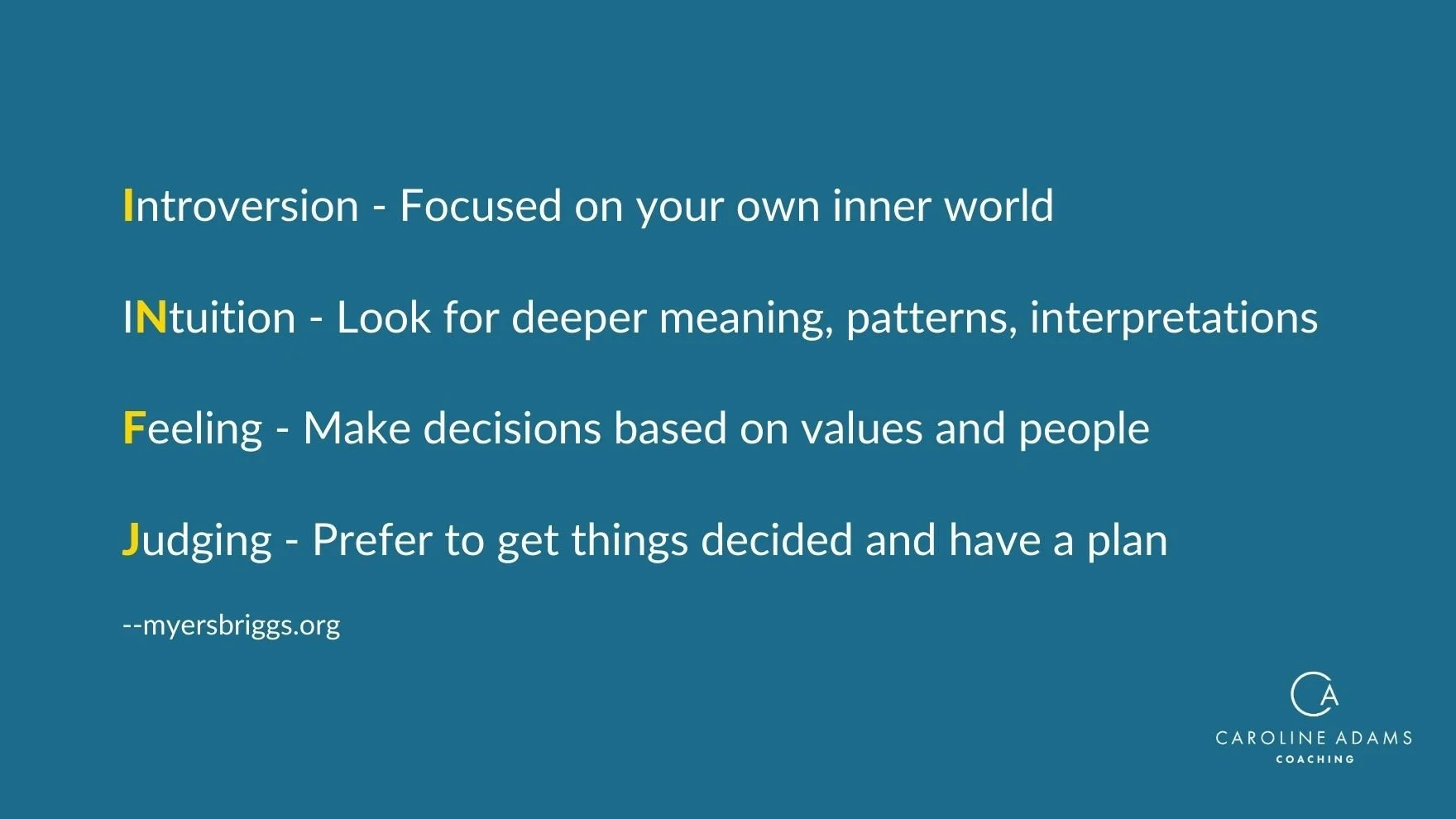
INFJ stands for Introverted, INtuitive, Feeling, Judging. Read the full INFJ profile.
This is the rarest personality type, making up less than 2% of the general population.
At their core, INFJs are altruistic and idealistic.
They’re drawn to solving society’s problems—big and small. They’re deeply focused on people and the underlying issues that affect human lives.
“Nothing lights up [INFJs] like creating a solution that changes people’s lives…”
— 16 personalities.com
(This honestly gives me chills.)
But don’t let INFJs’ rarity trick you into thinking there aren’t a lot of INFJ career opportunities.
In fact, the opposite is true when you know where to look.
You, INFJ, are a rare gem. You deserve a career that fits you.
1. Lean Into the INFJ Strengths That Differentiate You
Your rarity isn’t a problem; it’s the point.
INFJs often feel like the outlier—the one person in the room who sees things differently, comes to the opposite conclusion, or weighs factors others ignore.
And it’s normal to feel like that’s a disadvantage.
I want to challenge that and encourage you to treat your differences as a true benefit.
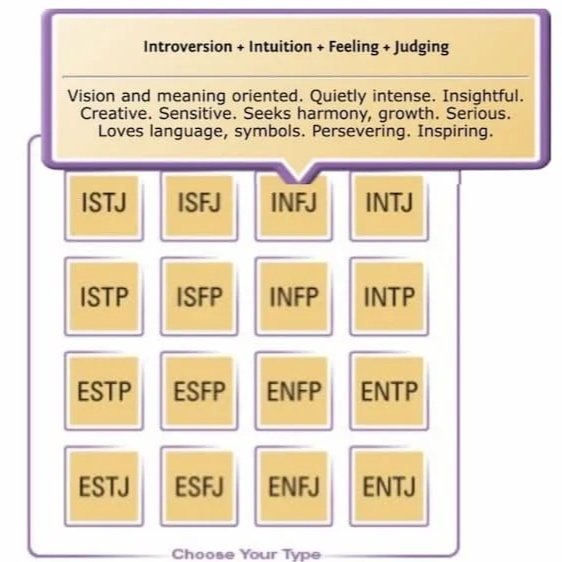
Look at these strengths! You’re amazing, INFJ.
Imagine you’re in a room with nine other people making a high-stakes decision that’s going to impact everyone in the organization.
Everyone’s talking. You got data flying around. There’s logic and reason. Competing priorities. Arguments on all sides.
And then you—you beautiful INFJ—swoop in.
You don’t just take the data at face value. You intuit the deeper meaning and how it impacts people.
You ask things like:
What are the special circumstances we need to consider?
What is this going to mean for our employees?
What are the broader implications beyond the bottom line?
Really making a decision with people at the forefront.
That’s leadership.
We’ll talk more later about your powerful communication skills, but because you can be quiet and reserved, when you do speak…people listen.
Perhaps this is why 16 personalities calls the INFJ personality type “The Advocate.”
You’re a really important voice for others.
This isn’t just a personal strength—it often differentiates you in a room full of people.
This also means context matters. The culture, norms, and environment you work in will either amplify this strength and make you feel valued…or slowly erode your confidence.
2. You Don’t Have to Choose: Go Beyond the Obvious Options
What are the potential career paths for INFJs? I’ll share some as a starting point, but I encourage you to go deeper.
You’ve likely seen the same, obvious INFJ career paths everywhere:
Counselors
Teachers
Coaches
Healers
Yoga instructors
If any of those options light you up—amazing. Go for it.
But I encourage you to go the next layer down.
For example, if you’re interested in teaching, but the idea exhausts you, don’t limit yourself to traditional options.
There are so many things you could teach. So many different populations to serve. So many environments in which you can operate beyond schools and classrooms.
A common INFJ trap is stopping at a job title like “teacher,” instead of defining what teaching means to you and exploring all the nuances of how you want to teach.
Examples of Unique INFJ Career Options
Another key INFJ strength is your ability to come up with outside-the-box solutions and to see connections others don’t.
That’s why a hybrid career could be a really great option for you.
I still remember a woman I met in university who was studying to become a Medical Illustrator—drawing the complex diagrams needed for medical journals and textbooks.
She took her love of art and love of medicine and combined them.
How cool is that?!
I’m working with an INFJ right now who’s looking for organizations that serve a larger purpose and make a real impact.
He’s looking to combine four seemingly disparate areas: music, sports, the outdoors, and breweries.
But it’s not just about having a cool music festival or working at a brewery, it’s about combining them in impactful ways:
How might this music festival raise money?
Partner with nonprofits?
Generate money for communities in need?
Soon he had a list of organizations and companies that worked at the intersection of these elements: The New York City Marathon, Athletic Brewing Co, and a beloved local music venue.
Hopefully this gets your juices flowing and helps you start thinking about all the options available to you.
If there are ten things you’re drawn to that you’d really like to explore, consider combining them.
If you feel stuck and like you have to choose one of them…just don’t. Play with how they fit together instead.
This kind of out-of-the-box thinking is exactly what we do in my course, Design a Career You Love. Download my free 4-step career roadmap for a taste of what we cover.
3. Your Communication Is a Strategic Asset
Especially when you get behind an idea or broader movement, you not only speak with passion and conviction but with warmth and sensitivity. That combination is rare…and incredibly valuable.
(As an INTJ whose instinct is to persuade with blunt force, I really love and appreciate that second piece).
I encourage you to think about where you want this communication strength to sit in your career.
For some INFJs, communication is the centerpiece: writing, journalism, speaking, media.
For others, it’s a defining edge inside another role: Think about a doctor explaining a complex procedure—not just clearly, but humanly. That ability changes outcomes.
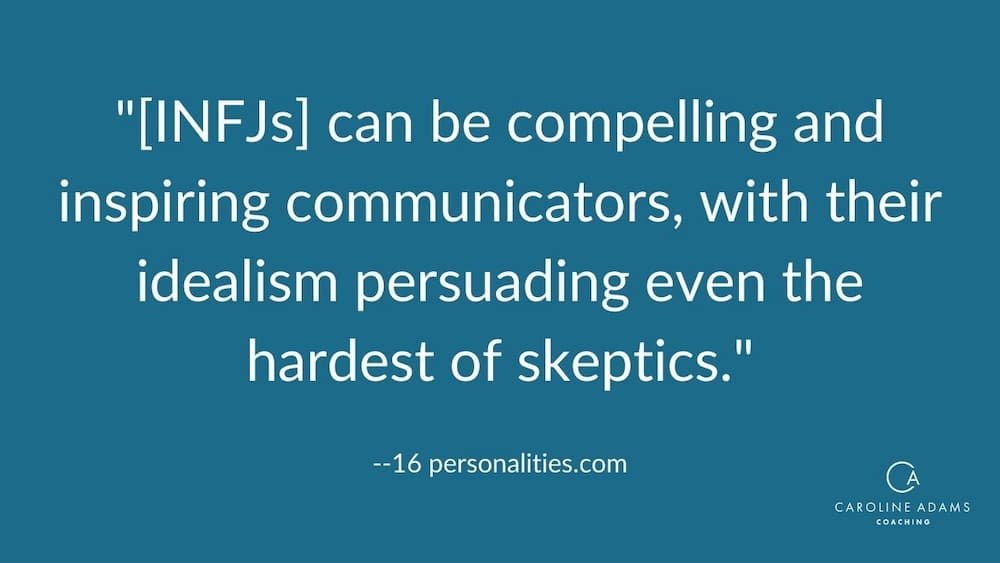
Your superior communication skills can enhance your effectiveness in ANY profession to inspire, persuade, connect, engage, defuse conflict, and deepen insights. Priceless.
And hopefully you’re starting to see how you can apply your many strengths to what you do and how you do it.
Wow. Just wow.
4. The Best INFJ Careers Don’t Just Focus On Roles—They Focus On Impact
INFJs are not idle dreamers.
You have big ideas, but you also want to see progress. You want to take action.
So when thinking about career change, don’t just ask what impact you want to make.
Ask how you want to see the fruits of your labor:
Is it one-on-one interactions so you can watch people grow and evolve?
Maybe it’s physically walking through a community you’re supporting so you can connect and see real change on the ground.
When I volunteered at a Food Bank, I loved working the mobile pantry events because I could talk to the clients face-to-face. Packing a box in a warehouse is important and needed, but being in the field felt much more rewarding.
INFJs need to know they’re helping and connecting with people.
This is why many INFJs struggle in roles where the impact is abstract or hidden—toiling away in a back room, disconnected from the people they’re meant to serve.
So what might feel like a career path problem may just be an environmental mismatch.
Ask yourself: Would I be happy doing the same work in a different environment? Or am I looking for wholesale change?
5. INFJ Work Environments to Avoid
INFJs tend to struggle in environments that are:
Overly bureaucratic or hierarchical
Focused on politics over purpose
Rigid, repetitive, or rule-bound
Dismissive of personal needs
Cutthroat, competitive, or conflict-heavy
These environments don’t just frustrate INFJs—they drain them. So I encourage you to avoid INFJ careers and jobs that have the above qualities (and any others) that don’t align with how you like to work.
Freedom and Flexibility Are Non-negotiable
Like INTJs, INFJs need freedom and flexibility to run with ideas.
You may not care about titles or org charts, but you do care about the authority to make things happen.
Maybe this means owning a department, leading initiatives, or carving out autonomy within a role.
However it looks, you need the freedom to do meaningful work, the space to maximize your creativity and insights, and agency to put your idealistic goals out into the world.
You need an environment that allows you to be at your best. And ideally, one that pulls your best out of you.
INFJs and Burnout
INFJs are especially prone to burnout because they care so deeply and often stay too long in environments that don’t support them.
When the mission feels important, INFJs can slip into patterns of over-giving in ways that come at the expense of their own needs.
The solution isn’t to care less.
It’s to make sure you’re also getting what you need.
The real work is finding win-win solutions—contributing in ways that nourish you and serve the other person. (I promise these exist!)
A hard but powerful lesson for INFJs is learning how boundaries don’t just protect your precious energy, but also benefit the people on the other side of those boundaries.
Burnout is an important signal that your environment or patterns of working need to change.
If this is resonating, I'm opening Design a Career You Love soon—a course built for INFJs who are tired of pouring energy into work that drains them. Join my email list for early access and details.
6. You’re Wired to Get to the Heart of Things
“INFJs typically strive to move past appearances and get to the heart of things. This can give them an almost uncanny ability to understand people’s true motivations, feelings, and needs.”
— 16 personalities.com
Read that again.
How powerful is that to understand people’s unspoken needs?
Just like we discussed with communication—this could be the centerpiece. Coaching, counseling, therapy are all about getting to the heart of the issue and understanding the deeper motivations and feelings beneath the surface.
But I’ve also had INFJs say to me, “Please don’t tell me to become a therapist.”
Your career gets to be based on your interests, remember?
So maybe for you this is about how you lead in the field of your choice: building consensus, motivating teams, helping your team stay engaged and feel seen.
No matter the field, this depth of thinking is a feature, not a side note.
There’s Limitless Potential For INFJ Careers
INFJs can thrive in a number of careers.
Do yourself a favor and don’t limit yourself to obvious job titles and career paths listed on personality websites (or any website for that matter).
If you’re an INFJ questioning your career, the answer isn’t to look for the “perfect job.”
It’s to understand:
What you’re uniquely good at that you also enjoy
What conditions help you do your best work
If you need help getting started, download my 4-step career roadmap. It’s the framework I use with every client that gives you the flexibility and space to make your own discoveries.
If you’re interested in my favorite assessments to help you create a career you love and thrive once you get there, check out How To Use Personality Assessments In the Workplace.
If you’d like to talk INFJ careers with an INTJ who’s created a unique career of her own, apply for a free strategy session.


Author Bio:
Caroline Adams is a career coach and fellow INTJ who helps professionals design work that fits how they think.
Before becoming a coach, Caroline had a successful career in change management consulting and financial services. She's made it her mission to help people grow, contribute, and get wherever they want to go in their careers.
Caroline wants you to recognize how much power you have to define your career. Take the first step by downloading your free 4-step career roadmap.



You do NOT have to go back to school to change careers. Here's when a degree actually matters—and the creative paths my clients have taken instead.